
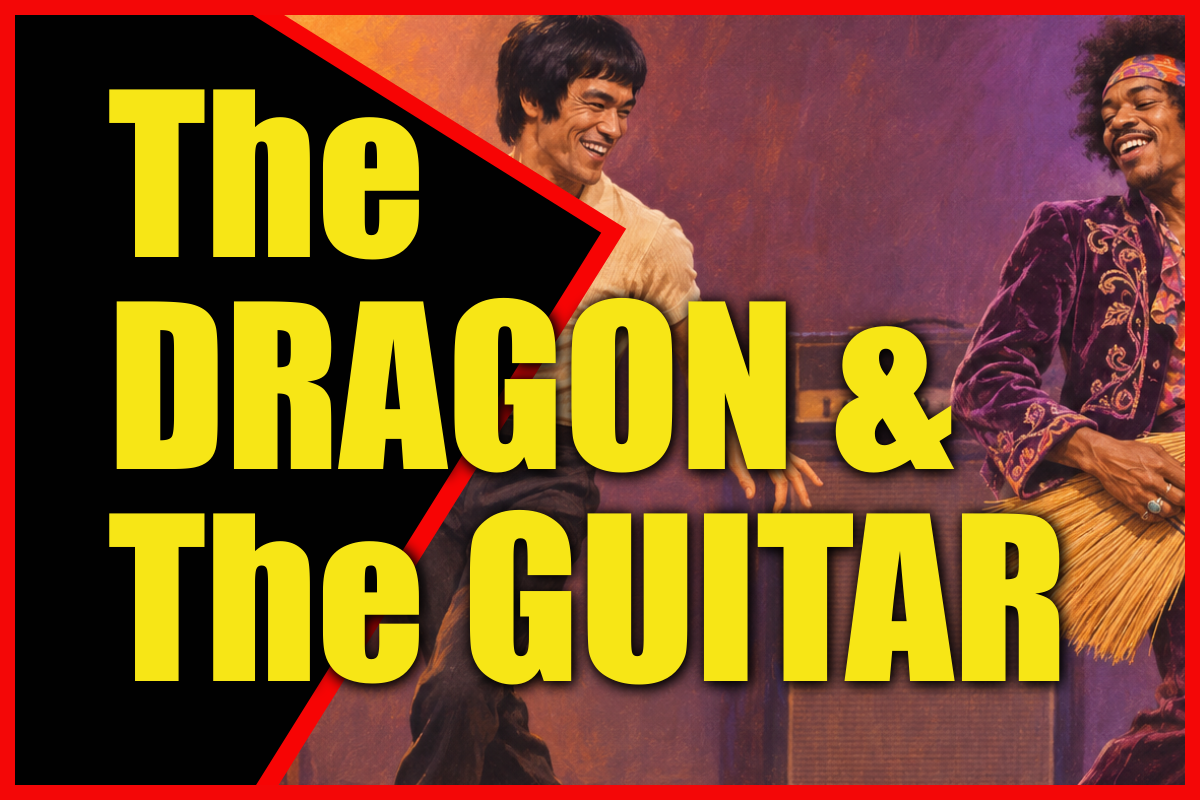
Bruce Lee and Jimi Hendrix: two legends born on the same day, a remembered meeting in Seattle, and two lives that changed the world.
By Rubén Darío Basay Roberts

Some coincidences seem made for a movie. Bruce Lee was born on November 27, 1940. Exactly two years later, on November 27, 1942, Jimi Hendrix came into the world.
One would revolutionize martial arts and cinema; the other would change the sound of the electric guitar forever. But before becoming legends, they were two young men with dreams, anxieties, family hardships, and unexpected passions. Even more surprisingly, a biographical account suggests that they briefly met in Seattle before either became famous.
Bruce Lee: the Dragon Who Danced the Cha-Cha
Long before he electrified movie audiences with his astonishing martial arts, Bruce Lee had another passion: dancing. In 1958 he won Hong Kong’s cha-cha championship. According to the Bruce Lee Foundation, his dance partner in the competition was his own brother, Robert. This was no casual hobby. Bruce recorded 108 cha-cha steps in a notebook, studying movement with the discipline he would later bring to martial arts. Music, balance, timing, and coordination already mattered to him. When he sailed to the United States in April 1959 with only about a hundred dollars, he even taught fellow passengers how to dance. In Seattle he worked at Ruby Chow’s restaurant, finished high school, and later attended the University of Washington. He taught martial arts and pursued philosophy with the same restless curiosity. The future screen icon was also a young man who loved learning and dared to begin again.
Jimi Hendrix: The Boy Who Turned a Broom into a Guitar
While Bruce was growing up in Hong Kong, Hendrix was experiencing an unstable childhood in Seattle. His family struggled financially, and his mother, Lucille, died in 1958, when he was fifteen. Music offered him both comfort and the possibility of a different life. His father, Al Hendrix, remembered asking young Jimi to clean his room, only to find bits of broom straw scattered around the bed. Jimi was using the broom to pretend he was playing a guitar. An ordinary household chore had become an imaginary concert. Later he acquired a one-string ukulele, and eventually a secondhand acoustic guitar bought for five dollars. He learned largely by ear, listening to blues and rock and roll. There is another lovely connection between the families: Al Hendrix had experience in competitive dancing and met Jimi’s mother, Lucille, at a dance. In different ways, music and movement were part of both men’s early lives.
The Guitarist Who Was Shy About Singing
Hendrix would go on to command enormous crowds, but he was not always comfortable with attention. Recording engineer Eddie Kramer recalled how shy and polite Jimi could be, especially when recording his voice. Studio screens helped give him privacy so that other people were not watching him sing. It is a touching contrast: a man capable of making his guitar roar before thousands of people sometimes needed a private corner to sing his own songs. He also carried a vivid imagination. His sister Janie has described how he wrote down lyrics and thoughts on hotel stationery, napkins, and whatever paper was available, and encouraged keeping a pencil and notepad by the bed to catch ideas from dreams. Behind the electric spectacle was a thoughtful, sensitive, imaginative human being.
Did They Meet in Seattle, 1961: At a Bowling Alley?
One of the most curious connections between the two artists comes from a remembered encounter. In Room Full of Mirrors, journalist Charles R. Cross recounts a story told by Denny Rosencrantz, an old acquaintance of Hendrix. According to Rosencrantz, the two young men crossed paths in the spring of 1961 at Imperial Lanes, a Seattle bowling alley—a place where friends gathered to roll heavy balls down wooden lanes and knock down ten pins. Hendrix, eighteen, had gone to watch his friends because he could not afford to bowl. Bruce Lee was twenty and was beginning to be noticed locally for his martial-arts demonstrations. Rosencrantz recalled that the two shook hands. Another published account places the encounter near a different Seattle bowling alley, so the precise location cannot be established with confidence. There is no known photograph of the handshake or independent evidence that the two became friends. We should therefore treat this as a biographical recollection, not a fully verified scene. Yet the possibility remains fascinating: two young men born on the same calendar day, destined to transform popular culture, perhaps exchanging a brief greeting while the world knew neither name.
Two Men Who Dared to Reinvent Themselves
Bruce Lee challenged the limits of rigid martial-arts systems and developed Jeet Kune Do, an approach emphasizing adaptability, economy, and individual expression. Hendrix, a left-handed guitarist, transformed right-handed guitars by reversing and adapting them, and explored sounds that helped redefine rock music. Both questioned conventions and faced racial prejudice in the societies in which they worked. One invented a new language through the movement of his body; the other found his voice in six strings, feedback, and electricity. Neither breakthrough happened overnight. Behind their apparent spontaneity lay sustained practice and courage.
Two Short Lives, an Immense Legacy
Jimi Hendrix died in London on September 18, 1970, at just twenty-seven. Bruce Lee died in Hong Kong on July 20, 1973, at thirty-two. Their lives were painfully brief. Their resting places share a final geographic connection: both are in the Seattle area, although in different cemeteries— Hendrix at Greenwood Memorial Park in Renton and Lee at Lake View Cemetery. On November 27, 2026, the world marks the eighty-sixth anniversary of Lee’s birth and the eighty-fourth of Hendrix’s. Perhaps the warmest tribute is to remember Bruce dancing cha-cha with his brother, and young Jimi turning a broom into an imaginary guitar. Before millions admired them, they were simply two young men determined to do what they loved. One turned movement into art; the other made music a language of freedom.
The Greatest Lesson They Left Us
Dreams are built with dedication, courage, willpower, and perseverance, even when the road seems impossible.
Thanks for reading, we hope you find it useful, please LIKE, SHARE and don’t forget to SUBSCRIBE to World of Martial Arts Television for more great content!!