
In Muay Thai, the more effective weapons you have at your disposal, the better the chances of you winning a fight are. In this article I’m going to talk about 5 essential Muay Thai strikes, how each one can be implemented in the ring and what the likely effects of each strike are.
Low kick
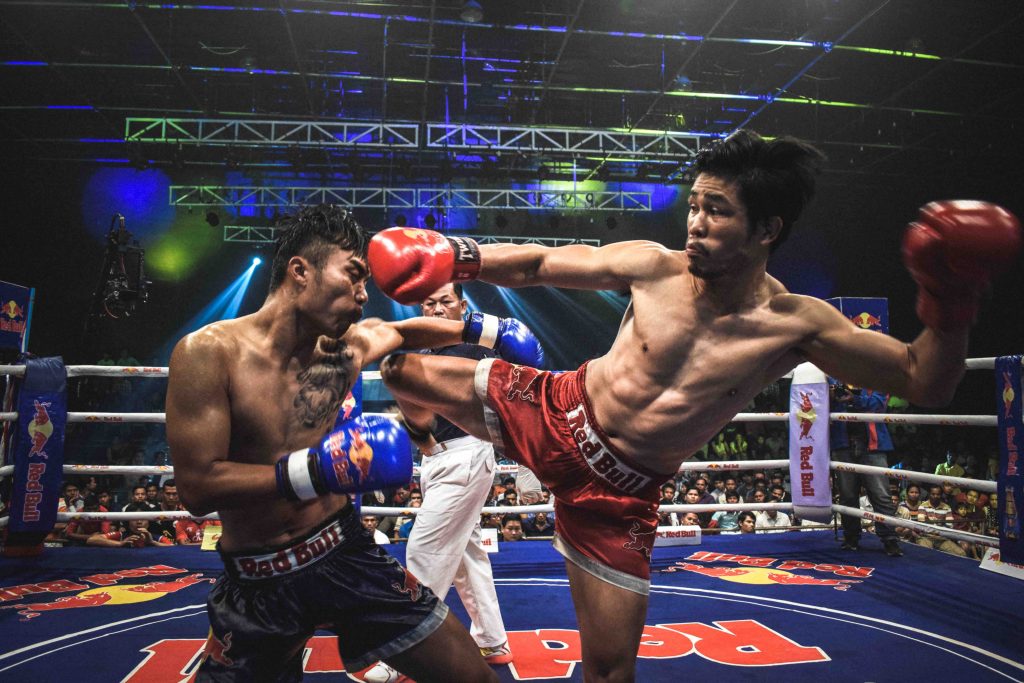
The low kick is arguably the most versatile kick in Muay Thai – it has so many uses, so many targets and delivered effectively is a key weapon for any Nak Muay.
The low kick involves kicking the opponent’s leg – either the lead leg or back leg to set up a combination or a follow up strike. Delivered accurately and powerfully, a low kick can even be enough to send an opponent to the canvas.
Most Muay Thai fighters will use the low kick as part of a combination – it’s usually either a set up for a follow up strike to the head, or as part of a combination of kicks. The low kick is perfect as a set up because it diverts the opponent’s attention to their legs, leaving a potential opening for a head strike.

Straight Knee (from standing to body)
The straight knee is a move that can be used to neutralise an oncoming attacker – if they’ve left themselves open after throwing a punch or kick, a powerful and accurate knee can bring the fight to an early close.
The main use of straight knees in Muay Thai however is as a point-scoring strike that wears down the opponent. The set up varies depending on your coach – some coaches teach the straight knee as a reactive movement, where you feint to trick the opponent into throwing a punch, which you avoid and take advantage of their inability to defend themselves with a powerful straight knee.
Other coaches encourage the spear knee as an attacking movement, where you launch an unexpected knee attack from standing. You may feint with a punch or kick beforehand, then launch the knee when it’s least expected.
Straight Cross
The straight cross is a power punch that has the potential to knock the opponent out. If it’s delivered effectively it is one of the most powerful punches available to a fighter – even if it doesn’t result in a knockout it’s a powerful enough punch to stun the opponent.
The straight cross is usually set up in a couple of ways…
- Following a low kick, which diverts the opponent’s attention to their legs. When there is a clear opening, you should throw the straight cross hard and to the chin, aiming to knock out the opponent.
- After a jab. The jab is used as both a range-finder to gauge the distance to the opponent and also as a distraction – the jab makes the opponent move to block, which allows you to follow up with a straight cross when their attention is diverted.
Knee from Clinch
Being good in the clinch is a huge advantage to a Muay Thai practitioner – the ability to deliver strikes from a difficult position improves your chances of landing an effective blow and winning the fight.
A well-timed and powerful strike with the knee can be enough to end a fight early. Even if it doesn’t, repeated knees from the clinch can be enough to wear an opponent down – they’re difficult to defend and really fatiguing. If nothing else, a good knee strike is a point-scoring move.
Set the knee up by taking a strong grip on your opponent in the clinch, limiting their movement. When you have the grip you need, deliver a powerful straight or sideways knee, aiming for the abdomen or the ribs. Drive hard, fast and repeatedly.
Spinning Back Elbow
The spinning back elbow is one of the most effective strikes in Muay Thai for a few reasons – it’s powerful, it’s difficult to defend against, it’s easy to hide from the opponent and throwing it leaves you in a relatively safe position at the end of the movement.
A spinning back elbow is a good strike to use against an opponent who is strong defensively and is able to read many of your attacks. It’s a relatively easy strike to hide – you can feint with a kick and use the momentum to spin into the back elbow.
Additionally, you can use an opponents attack to your advantage – as they launch a strike you can avoid it by spinning away and continuing straight into the spinning back elbow.
An effective spinning back elbow can quite easily knock out an opponent, but even if it doesn’t it can still knock an opponent off-balance and into a position where it can be followed up with a further attack.
Darren Mitchell is a Muay Thai enthusiast and writer for the BestMuayThai blog. Darren has trained Muay Thai for several years at gyms all over the world alongside some world-renowned fighters and coaches.